
Quick answer: Stainless steel cookware is made in ten main stages. The steel coil is inspected and cut into round blanks, the blanks are deep drawn into pot bodies, and the bodies are trimmed and rim formed. A heat-spreading base is bonded on, or the body is drawn from pre-bonded clad sheet. Handles are attached, the pot is polished, cleaned and passivated, then marked, assembled with its lid and packed. Each stage has its own typical defects, so the quality of a finished pot depends on checks made at every step, not only at final inspection.
This guide follows a stainless steel pot from steel coil to finished product. It is written for importers, retailers and brand owners who want to understand what happens inside a cookware factory, which decisions change cost and performance, and where to look when auditing a supplier. It also covers points that most process overviews skip: coil inspection, draw stages, bottom bonding methods, handle attachment options, passivation, stage-by-stage quality checkpoints and the defects that each stage can cause.
What do most explanations of cookware manufacturing leave out?
Most explanations of how stainless steel cookware is made list the same main steps: cutting blanks, annealing, deep drawing, forming the rim, bonding layers, attaching handles, polishing and packing. Some describe a single brand workshop in detail, and others give a general overview for buyers. They are useful for understanding the sequence, but they rarely explain what can go wrong at each stage or how a buyer can check it.
The missing pieces are practical. Few guides explain how the incoming coil is verified, why deep pots need several draw stages, how impact bonding differs from brazing and fully clad construction, when riveted handles are better than welded ones, what passivation does, or which quality checkpoint belongs to which stage. This article fills those gaps so that buyers can connect each production step to the quality they receive.
What are the main stages of stainless steel cookware production?
The main stages of stainless steel cookware production are coil inspection, blanking, deep drawing, trimming and rim forming, base bonding, handle attachment, polishing, cleaning and passivation, marking, and final assembly and packing. The order can change slightly between factories and products, but every stainless steel pot passes through these functions in some form.
| Stage | What happens | Main quality risk |
|---|---|---|
| 1. Coil inspection | Steel grade, thickness and surface are verified | Wrong grade or thin material |
| 2. Blanking | Round blanks are cut from the coil | Burrs and incorrect diameter |
| 3. Deep drawing | Blanks are pressed into pot bodies | Cracks, wrinkles and wall thinning |
| 4. Trimming and rim forming | Edges are trimmed and rolled or flared | Sharp edges and uneven rims |
| 5. Base bonding | Aluminum or clad base is bonded for heat spread | Weak bond, gaps or uneven base |
| 6. Handle attachment | Handles are riveted, welded or screwed | Loose handles and weld marks |
| 7. Polishing | Surfaces are ground and polished in stages | Waves, drag lines and burn marks |
| 8. Cleaning and passivation | Polishing residue is removed and the surface is restored | Residue and early rust spots |
| 9. Marking | Logo and information are etched or laser marked | Unclear or misplaced marks |
| 10. Assembly and packing | Lids and accessories are added and packed | Mismatched parts and transit damage |
How is the stainless steel coil checked before production starts?
The stainless steel coil is checked before production by comparing its grade, thickness, width and surface condition with the order specification. Factories receive coils with a mill certificate that states the chemical composition, but a responsible factory also verifies the material on site. A portable XRF analyzer can confirm the grade quickly, and a micrometer confirms thickness at several points across the coil width.
This step matters because the grade cannot be changed later. A pot drawn from 201 steel instead of 304 steel looks almost identical when new but behaves differently in corrosion resistance. Our guide to XRF testing for cookware explains how to verify the grade, and the comparison of 304 vs 316 vs 430 stainless steel explains which grade suits each part of a pot.
| Grade | Main use in cookware | Magnetic |
|---|---|---|
| 304 (18/8) | Pot bodies and cooking surfaces | No, or very slightly after forming |
| 316 | Premium cooking surfaces with higher corrosion resistance | No |
| 430 | Induction base caps and some economy bodies | Yes |
| 201 | Economy bodies and accessories | No, or slightly |
How are round blanks cut from steel coil?
Round blanks are cut from steel coil by a blanking press or cutting line that stamps circles of a calculated diameter from the flat strip. The blank diameter is larger than the finished pot base because the metal must flow up to form the walls. Engineers calculate the diameter from the target height, wall thickness and the material lost when the rim is trimmed.
The coil is usually slit to a width that fits the blank size, and blanks are arranged to reduce scrap between circles. Scrap rate affects cost directly, which is why material efficiency is part of every cookware quotation. After cutting, blanks are checked for burrs and diameter, because a burr on the blank edge can tear during drawing.
How does deep drawing turn a flat blank into a pot?
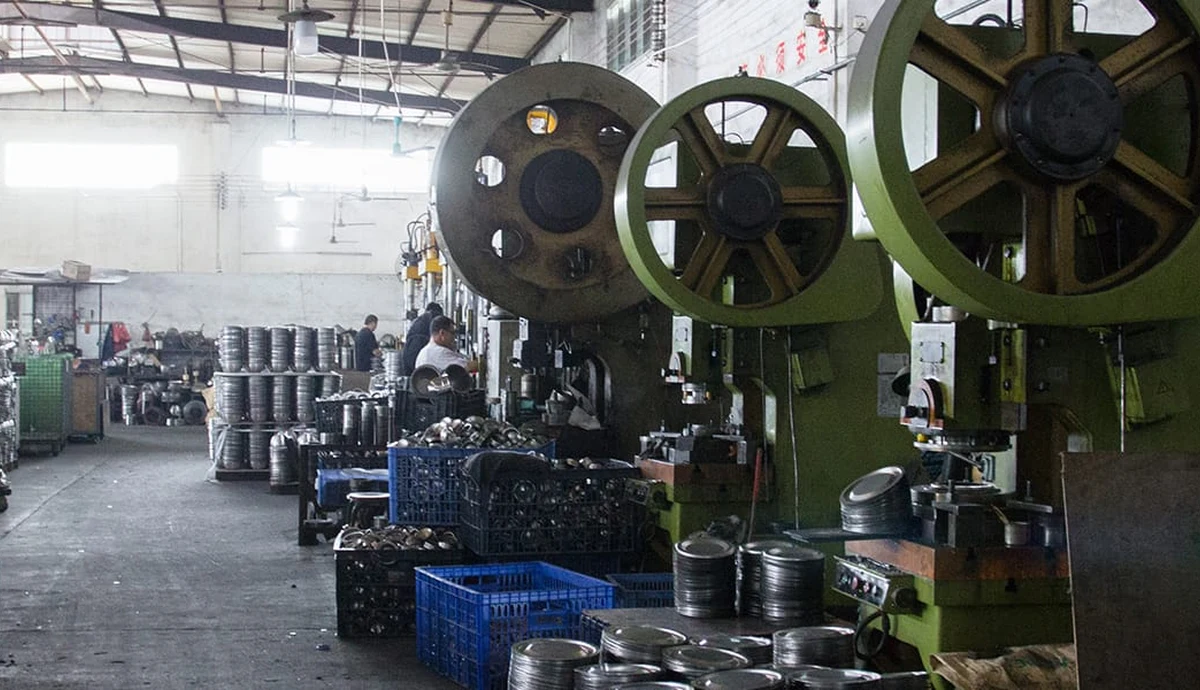
Deep drawing turns a flat blank into a pot by pressing it into a die with a punch, so the metal flows from the flat circle into a cup shape. A blank holder controls the edge of the blank and prevents wrinkles while the punch descends. Drawing oil lubricates the surface so the steel slides into the die without tearing or scratching.
Shallow pans can often be drawn in one stage, but tall stock pots usually need two or more draw stages. Each stage reduces the diameter and increases the height a little more. Stainless steel hardens as it is worked, so very deep shapes may need annealing between stages to soften the metal again and avoid cracks. Wall thickness also changes during drawing, usually thinning near the lower wall, which is why buyers should measure wall thickness at several heights.
| Pot shape | Typical draw stages | Main forming risk |
|---|---|---|
| Frying pan or shallow skillet | One | Uneven flatness of the base |
| Saucepan or casserole | One or two | Wrinkles near the rim |
| Tall stock pot | Two or more, sometimes with annealing | Cracks and wall thinning |
How are pot rims trimmed and formed?
Pot rims are trimmed and formed after drawing to remove the uneven top edge and give the pot its final height and rim profile. A trimming tool cuts the rim to the correct height, and then the edge is rolled, curled, flared or left as a straight cut edge depending on the design. The rim shape affects safety, strength, lid fit and pouring.
| Rim type | Advantage | Consideration |
|---|---|---|
| Rolled or curled rim | Strong and smooth, no sharp edge | Can trap residue if not finished well |
| Flared pour rim | Drip-free pouring | Needs careful lid matching |
| Straight cut rim | Clean modern look and easy cleaning | Edge must be ground and polished smooth |
After rim forming, the bodies are washed to remove drawing oil. This first wash is important, because oil left on the surface interferes with bonding, welding and polishing in the following stages.
How is the heat-spreading base added to stainless steel cookware?
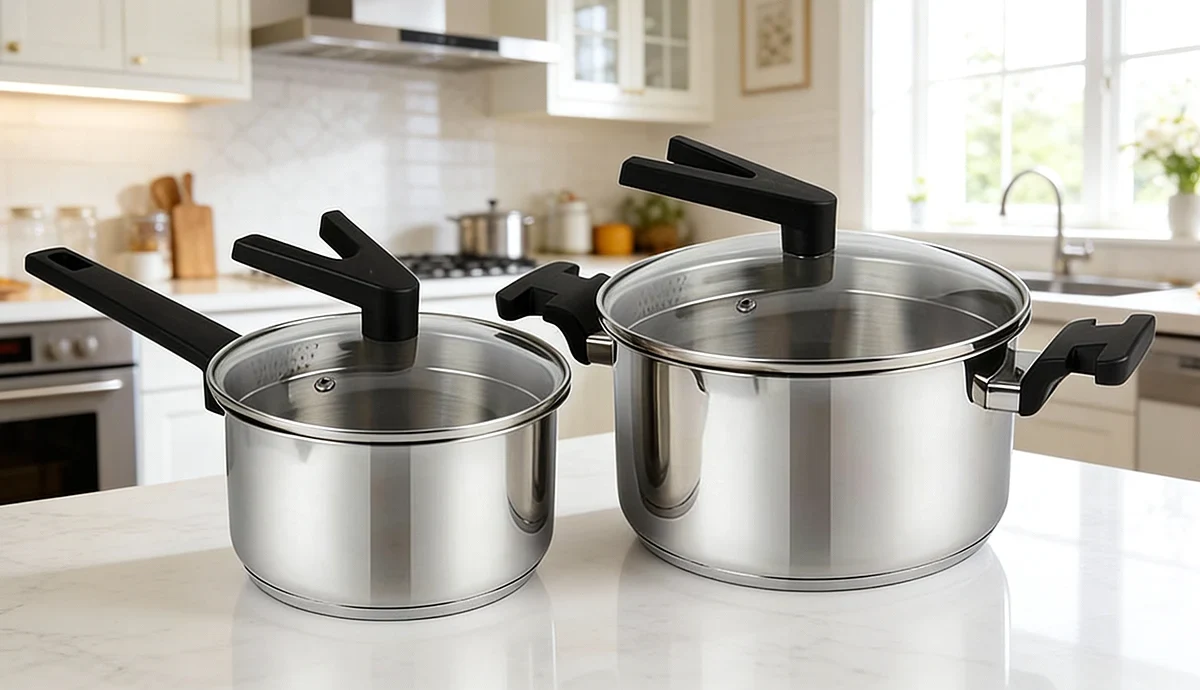
The heat-spreading base is added in one of three ways: impact bonding an aluminum disc under the pot, brazing a sealed capsule base, or drawing the whole body from pre-bonded clad sheet. Stainless steel alone conducts heat poorly, so aluminum or copper layers are used to spread heat evenly across the cooking surface.
Impact bonding heats the pot bottom, an aluminum disc and a stainless steel cap, then joins them with a high-tonnage press. The result is a thick base that heats evenly, and a magnetic 430 cap makes the pot suitable for induction cooktops. Fully clad cookware uses sheet in which stainless and aluminum layers are already bonded, so the conductive layer runs up the walls as well. The guides to capsule bottom cookware and tri-ply vs fully clad cookware compare the two constructions in detail.
| Construction | How the base is made | Heat behavior | Cost level |
|---|---|---|---|
| Single layer | No added base, body only | Hot spots, slower even heating | Lowest |
| Impact bonded capsule base | Aluminum disc and steel cap pressed onto the bottom | Even heat across the base, walls stay cooler | Medium |
| Brazed capsule base | Base layers joined with a brazing alloy | Even base heat when the bond is complete | Medium |
| Fully clad (tri-ply or more) | Body drawn from pre-bonded multi-layer sheet | Even heat on base and walls | Highest |
Bonding quality is checked by inspecting the edge of the base for gaps, measuring base flatness and running heating and cooling cycles. A weak bond can separate after repeated heating, causing noise, uneven cooking or a visibly lifted base. Some buyers ask whether this stage uses glue; our article on adhesives in cookware manufacturing answers that question.
How are handles attached to stainless steel pots?
Handles are attached to stainless steel pots by riveting, spot welding or screwing onto welded studs. Each method has a different balance of strength, cleaning ease and appearance. The choice depends on pot weight, handle material, target price and how the cookware will be used.
| Method | How it works | Strengths | Trade-offs |
|---|---|---|---|
| Riveting | Rivets pass through the wall and the handle bracket | Very strong, suits heavy pots and professional use | Rivet heads inside the pot need cleaning care |
| Spot welding | Handle brackets are welded to the outside wall | Smooth interior with no rivet heads | Weld quality must be controlled to avoid weak points or marks |
| Screwed on welded studs | Studs are welded on, handles are screwed to them | Allows non-metal handles and easy replacement | Screws can loosen over time without proper design |
Handle attachment is tested by hanging a load from the handle or loading the pot and checking for movement. Factories with in-house accessory lines can control handle, knob and bracket dimensions more closely, which reduces fit problems at assembly.
How is stainless steel cookware polished?
Stainless steel cookware is polished in several stages, starting with coarse abrasives to remove drawing marks and finishing with fine abrasives or buffing compounds for the final appearance. The interior and exterior can receive different finishes, such as a mirror exterior with a satin interior, or a brushed finish all over. Each stage removes the scratches left by the previous one.
| Finish | Appearance | Typical use |
|---|---|---|
| Mirror polish | Highly reflective, bright | Retail cookware sets and premium exteriors |
| Satin or brushed | Soft matte with fine lines | Interiors and professional cookware |
| Sandblasted | Even matte texture | Exteriors and surfaces that will be coated |
| Hammered or patterned | Decorative texture | Design-led product lines |
Polishing defects such as waves, burn marks, drag lines and pits are easiest to see under raking light. Our cookware polishing defect atlas shows each defect, its cause and how to set an acceptance standard with a supplier.
Why do cookware factories clean and passivate stainless steel pots?
Cookware factories clean and passivate stainless steel pots to remove polishing compounds, metal particles and oil, and to restore the protective chromium oxide layer on the surface. Polishing can leave fine iron particles from abrasives or tools on the steel. If they remain, they can cause small rust spots that look like a material defect even when the steel grade is correct.
Cleaning usually combines alkaline washing and rinsing, sometimes with ultrasonic tanks for complex shapes. Passivation uses a controlled acid treatment, often citric or nitric based, that removes free iron and helps the natural oxide layer form evenly. Buyers who sell into humid or coastal markets, or who have experienced early rust complaints, should state their cleaning and passivation requirement in the purchase specification.
How are logos and markings added to cookware?
Logos and markings are added to cookware by laser marking, electrochemical etching, stamping or printing, usually on the base or the handle. The marking can include the brand, capacity, material grade, induction symbol and care information. Laser and etched marks are permanent and suit the base, while printed marks are more common on packaging and labels.
For private label orders, the marking position, size and content should be approved on a sample before mass production. Changing a base marking after production starts usually means changing tooling or fixtures, which delays the order.
What happens during final assembly and packing?
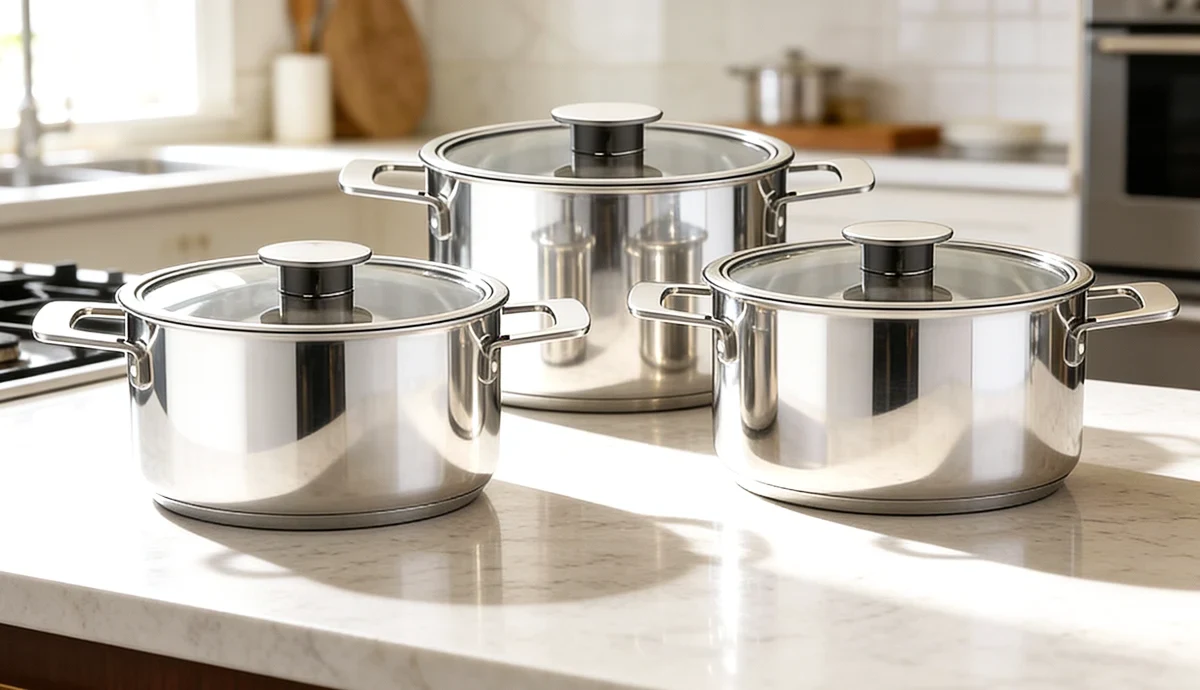
During final assembly and packing, each pot is matched with its lid, knobs and accessories, inspected again and packed into retail or bulk packaging. Glass lids are checked for fit, rim smoothness and venting, and stainless steel lids are checked for alignment with the pot rim. Our article on why glass pot lids should be edged explains one of the most common lid quality points.
Packaging protects polished surfaces and prevents parts from rubbing during transport. Typical packing includes protective film or paper between nested pieces, a color box or gift box for retail sets, and an export carton sized for the pallet and container plan. Factories with an in-house packaging printing center can coordinate box artwork and production timing more easily.
Which quality checks belong at each stage of cookware production?
Each stage of cookware production needs its own quality check, because many defects cannot be detected or repaired once the next stage has started. A crack hidden under a bonded base, a wrong steel grade or a weak rivet will not be visible at final inspection. A stage-by-stage plan catches these problems when they are still cheap to correct.
| Stage | Check | Tool or method |
|---|---|---|
| Incoming coil | Grade, thickness, surface | Mill certificate, XRF analyzer, micrometer |
| Blanking | Diameter and burrs | Caliper, visual and touch check |
| Deep drawing | Cracks, wrinkles, wall thickness | Visual check, thickness gauge at several heights |
| Rim forming | Height, roundness, edge smoothness | Height gauge, lid fit check |
| Base bonding | Bond completeness, flatness | Edge inspection, flatness gauge, heat cycle test |
| Handle attachment | Strength and alignment | Load test, visual check of rivets or welds |
| Polishing | Surface defects | Raking light inspection against approved samples |
| Cleaning and passivation | Residue and rust risk | Wipe test, water spray or salt spray sampling |
| Final and packing | Dimensions, completeness, packaging | Sampling inspection, carton drop test |
Food-contact compliance is a separate layer of quality control. Depending on the market, cookware may need test reports for food contact safety, such as FDA or LFGB testing. The guide to food-grade certifications for cookware explains which documents importers need.
Which common cookware defects come from which production stage?
Most cookware defects can be traced back to one production stage, which makes them easier to prevent once the cause is known. Linking each complaint to its stage helps buyers and factories fix the process instead of repeatedly sorting out bad pieces.
| Defect | Likely stage | Typical cause |
|---|---|---|
| Cracks near the base corner | Deep drawing | Too much reduction in one stage or work-hardened steel |
| Wrinkles near the rim | Deep drawing | Blank holder pressure too low |
| Rocking or domed base | Base bonding | Uneven bonding pressure or cooling |
| Noise or lifting base after heating | Base bonding | Incomplete bond or trapped contamination |
| Loose handle | Handle attachment | Weak rivet setting or poor weld |
| Waves and drag lines | Polishing | Uneven pressure or skipped abrasive stages |
| Small rust spots on new pots | Cleaning and passivation | Free iron particles left on the surface |
| Lid rocks on the rim | Rim forming or assembly | Out-of-round rim or wrong lid size |
How can buyers audit a stainless steel cookware factory step by step?
Buyers can audit a stainless steel cookware factory by walking the production line in the same order as the pot is made and asking for evidence at each stage. Instead of only reviewing certificates in an office, the buyer should see coil records, drawing presses, bonding equipment, handle lines, polishing areas, cleaning lines and packing in operation.
- Ask to see the mill certificate and incoming inspection record for the coil used in your order.
- Measure wall thickness on a drawn body at the base, lower wall and upper wall.
- Check the edge of bonded bases for gaps and ask about heat cycle testing.
- Test handle strength on a sample and check rivet heads or welds.
- Compare polished pieces with the approved golden sample under raking light.
- Ask how pots are cleaned after polishing and whether passivation is used.
- Confirm how marking, lid matching and packaging are checked before shipment.
A factory that can answer these questions with records and equipment on the floor is more likely to deliver consistent batches. Buyers planning their first custom order can also read the custom cookware OEM process guide and the cookware manufacturer MOQ guide.
Frequently asked questions
What steel is used to make stainless steel pots?
Most stainless steel pots use 304 stainless steel, also called 18/8, for the body and cooking surface. Premium lines may use 316 steel, and 430 magnetic stainless steel is often used for the induction cap on the base. Economy products sometimes use 201 steel, which costs less but has lower corrosion resistance.
Is stainless steel cookware forged or stamped?
Most stainless steel cookware is stamped and deep drawn from sheet rather than forged. Deep drawing presses a flat blank into a seamless body, which is efficient and produces consistent walls. Forging is more common for thick aluminum cookware than for stainless steel pots.
Why do some stainless steel pots have a thick bottom?
Some stainless steel pots have a thick bottom because an aluminum disc and a stainless steel cap have been bonded to the base. The aluminum spreads heat evenly, and the magnetic cap allows the pot to work on induction cooktops. Single-layer pots without this base are lighter but heat less evenly.
Why does new stainless steel cookware sometimes show rust spots?
New stainless steel cookware can show small rust spots when iron particles from polishing or tools remain on the surface. The steel itself may be correct, but the contamination rusts. Proper cleaning and passivation after polishing remove these particles and prevent the problem.
How long does it take to manufacture a custom cookware order?
The time to manufacture a custom cookware order depends on whether new molds are needed, the order quantity, the base construction and the packaging. Orders using existing molds move faster, while new shapes need mold design, sampling and approval before mass production begins.
Which production stage has the biggest effect on cooking performance?
The base bonding stage has the biggest effect on cooking performance, because it determines how evenly the pot heats and whether it works on induction. Steel grade and wall thickness also matter, but a poorly bonded base causes hot spots and can separate over time.
Work with a stainless steel cookware manufacturer that controls every stage
Changwen is a stainless steel cookware manufacturer in Xinhui District, Jiangmen, Guangdong, China, with more than 20 years in stainless steel cookware production. The factory produces stainless steel pots and pans for wholesale and OEM and ODM customers, and controls the main stages described in this guide in house.
- Larger-tonnage impact bonding machines for capsule bases, including larger base diameters for frypans and casseroles.
- In-house production lines for handles and accessories, and self-developed molds designed and tested weekly for new markets.
- An in-house testing lab, whole-process monitoring from raw material to packing, and QC staff in every workshop.
- Materials that meet FDA and LFGB testing requirements, with ISO 9001:2015, LFGB and BSCI certifications. See our certificates and quality control pages.
- An in-house packaging printing center for color boxes and private label packaging.
- Free samples so you can check quality before ordering.
Changwen exhibits at international trade shows, including exhibitions in Mexico, Chicago and the Canton Fair, and ships stainless steel cookware to customers around the world. To discuss a custom or wholesale order, send your design, sizes, steel grade, base type and quantity to info@cwchangwen.com, call 0086-18022963948, or use the contact page. You can also learn more about our R&D and manufacturing and custom kitchenware services.
-

Honeycomb Structure Stainless Steel Frying Pan CW-ETP014
-
Commercial Stainless Steel Stock Pot CW-SP001
-
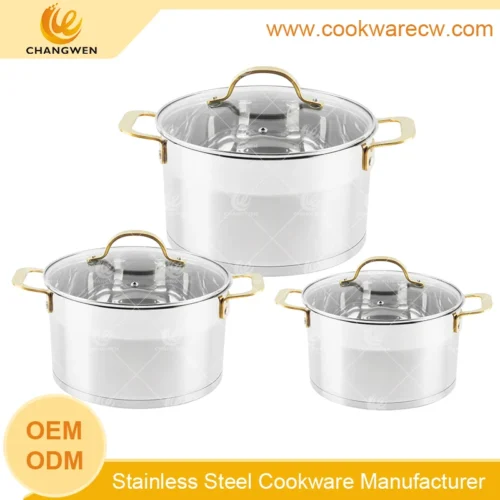
6-Piece Matte Stainless Steel Pot Set with Multi-Color Handles CW-ES0617
-
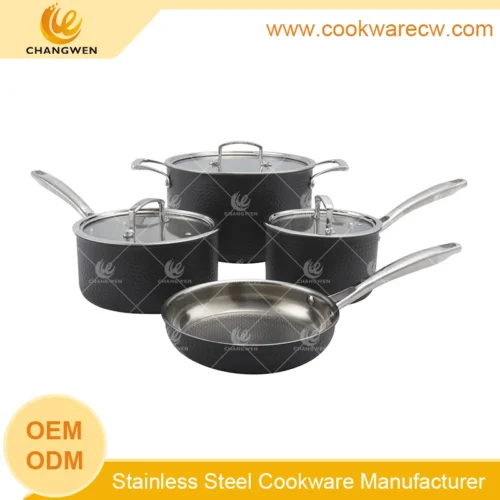
Black Hammered Stainless Steel Cookware Set CW-ETP0702
-
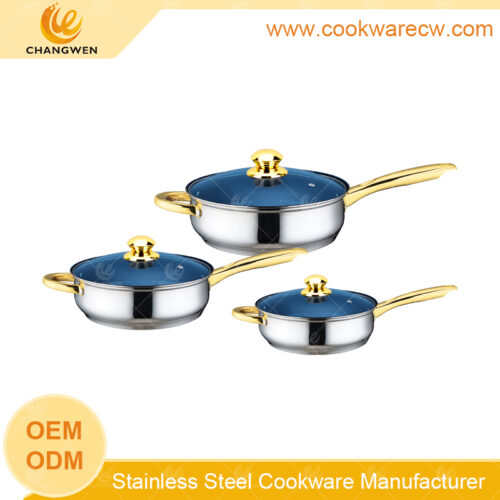
Best Nonstick Stainless Steel Pan
-
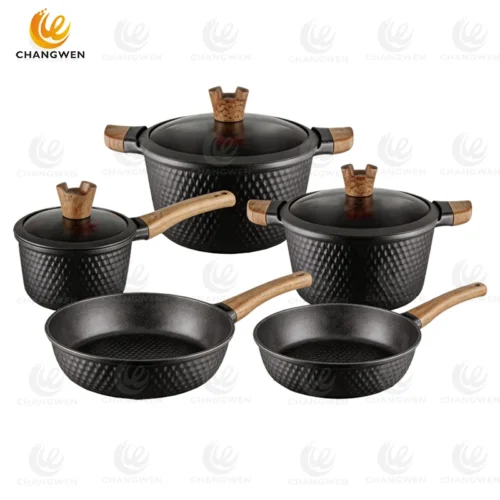
8pcs Die Cast Aluminum Cooking Set with Marble Ceramic Nonstick Coating
-
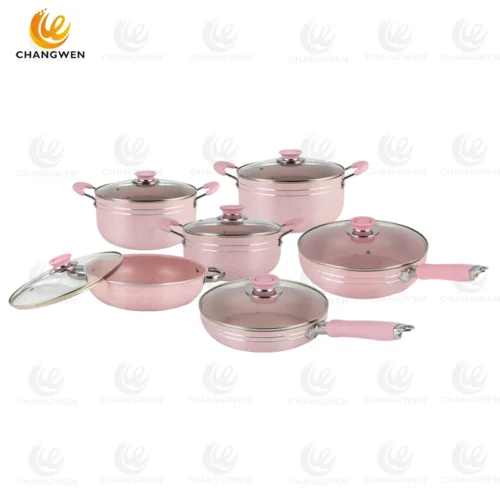
Ceramic Non Stick Aluminum Cookware Set
-
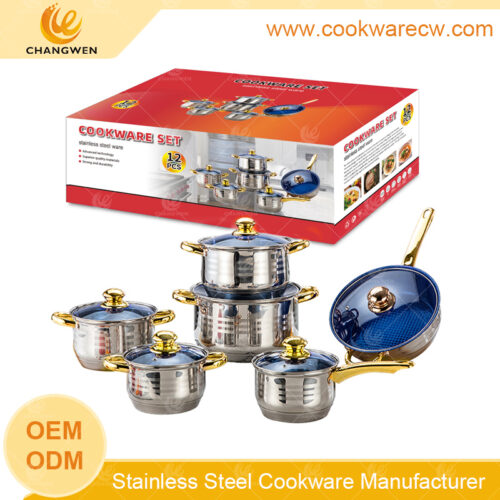
hot sales 12pcs stainless steel cookware set saucepan casserole non-stick frypan with golden handles & knobs & 5-stepped capsule bottom CW-M1202