
Estimated reading time: 12 minutes
Impact bonded bottom cookware is stainless steel cookware engineered with a thick, multi-layer heat-conductive aluminum (or copper-aluminum) disc permanently fused onto the base of a single-wall stainless steel pot or pan under 1,000 to 2,500 tons of mechanical impact pressure—without chemical adhesives or brazing solder. By pairing a corrosion-resistant 304 (18/8 or 18/10) stainless steel cooking interior, a fast-conducting aluminum thermal core, and a ferromagnetic 430 stainless steel outer induction cap, impact bonded cookware delivers rapid, even base heating and full induction compatibility at a lighter weight and 30% to 50% lower cost than fully clad tri-ply cookware.
While stainless steel is prized in home and commercial kitchens for its non-reactive cooking surface, hygiene, and scratch durability, bare stainless steel is a poor thermal conductor (roughly 15 W/m*K compared to ~205 W/m*K for aluminum). Impact bonding solves that physics problem right where heat enters the vessel. In this complete guide, we explain how impact bonding works inside a modern cookware factory, how it outperforms furnace-brazed capsule bases and compares against fully clad tri-ply construction, why base thickness and concave cold-flatness engineering prevent warping on induction cooktops, and what quality tests B2B importers and retail brands should require.
How does impact bonded bottom cookware compare to brazed capsule and fully clad tri-ply cookware?
Stainless steel cookware generally falls into three structural architectures: impact bonded bottom, furnace-brazed encapsulated bottom, and fully clad tri-ply (or 5-ply) roll-bonded cookware. Although impact bonded and brazed pans look similar from the outside because both concentrate their conductive metal inside a bottom disc, their internal bonding metallurgy, induction acoustic behavior, and thermal-shock durability differ sharply. Fully clad tri-ply cookware extends the aluminum core all the way up the sidewalls, offering unmatched sidewall heat at a higher weight and retail price.
| Engineering Parameter | Impact Bonded Bottom | Encapsulated Brazed Bottom | Fully Clad Tri-Ply (Full Body) |
|---|---|---|---|
| Conductive Core Coverage | Base disc only (edge-to-edge on quality models) | Base disc only | Base and entire sidewall up to the rim |
| Metallurgical Bonding Method | 1,000-2,500 ton friction/hydraulic impact press (solid-state interlock, zero filler) | Furnace soldering using brazing filler alloy | Roll-bonded multi-layer sheet deep-drawn into vessel |
| Micro-Void & Air-Gap Risk | Very low (plastic aluminum flow fills micro-cavities) | Moderate to high (solder voids create local hotspots) | Negligible (continuous factory-rolled bond) |
| Induction Cooktop Performance | Strong, quiet magnetic coupling with flat 430 cap | Can buzz, hum, or heat unevenly if braze voids exist | Strong, uniform coupling across base and lower curve |
| Vessel Weight & Ergonomics | Lighter sidewalls; easy to lift on large stockpots | Lighter sidewalls, bottom-heavy feel | Heavier overall due to thick multi-ply walls |
| Sidewall Heat Distribution | Moderate (heat concentrates strongly in base) | Moderate (sidewalls stay noticeably cooler) | Excellent (ideal for sauce reductions & sauteing) |
| Typical Wholesale / Retail Tier | High-value mainstream retail & HoReCa commercial | Entry-level promotional / budget tier | Mid-to-premium & culinary flagship tier |
If you are mapping an entire product line across multiple retail price tiers, compare these base constructions alongside our capsule bottom cookware buying guide and our tri-ply stainless steel cookware ultimate guide.
What is the exact 3-layer metallurgical stack-up inside an impact bonded base?
A standard commercial-grade impact bonded cookware base consists of three distinct metal layers selected for complementary chemical, thermal, and magnetic properties: the austenitic stainless steel vessel body, the high-purity aluminum heat-spreading disc, and the ferritic stainless steel outer induction plate. Changing the grade or millimeter thickness of any single layer alters heating speed, warp resistance, and landed unit cost.
- Inner cooking body (304 or 316L stainless steel, 0.5 to 0.8 mm wall): Food-grade 304 (18% chromium, 8% to 10% nickel) stainless steel forms the deep-drawn pot body. It resists acidic tomato sauces, wine reductions, and brine corrosion without leaching flavor. For heavy coastal, salt-heavy, or premium medical-grade positioning, 316L adds molybdenum for superior pitting resistance—a trade-off detailed in our 304 vs. 316 vs. 430 stainless steel cookware comparison.
- Thermal core disc (1050 or 3003 pure aluminum, 2.5 to 5.5 mm thick): Pure 1050 aluminum delivers ~220 W/m*K thermal conductivity and high ductility, allowing it to spread burner heat laterally across the entire base and flow cleanly under impact-press force. Budget promotional cookware often skimps down to 1.8 to 2.2 mm aluminum, which heats unevenly and warps quickly; mainstream retail cookware uses 3.0 to 4.0 mm aluminum; and heavy-duty HoReCa restaurant stockpots use 4.5 to 5.5 mm aluminum (or a 5-layer aluminum-copper-aluminum core) for massive thermal stability.
- Outer induction cap (430 ferritic stainless steel, 0.4 to 0.6 mm thick): Because 304 stainless steel is non-magnetic and will not trigger induction coils, impact bonded bases seal the bottom with ferromagnetic 430 stainless steel (16% to 18% chromium, virtually zero nickel). The 430 cap converts oscillating magnetic fields into rapid eddy-current heat, transfers that heat immediately into the aluminum core, and protects the aluminum from scratches and stove grates.
Equally important is base disc diameter coverage: if the aluminum disc is undersized relative to the flat bottom radius of the pot, an unbonded ring forms around the outer perimeter where food scorches during sauteing. Review why edge-to-edge coverage matters in our engineering study on cookware base disc diameter and heating coverage.
How is impact bonded bottom cookware manufactured on a 1,600-ton press line?
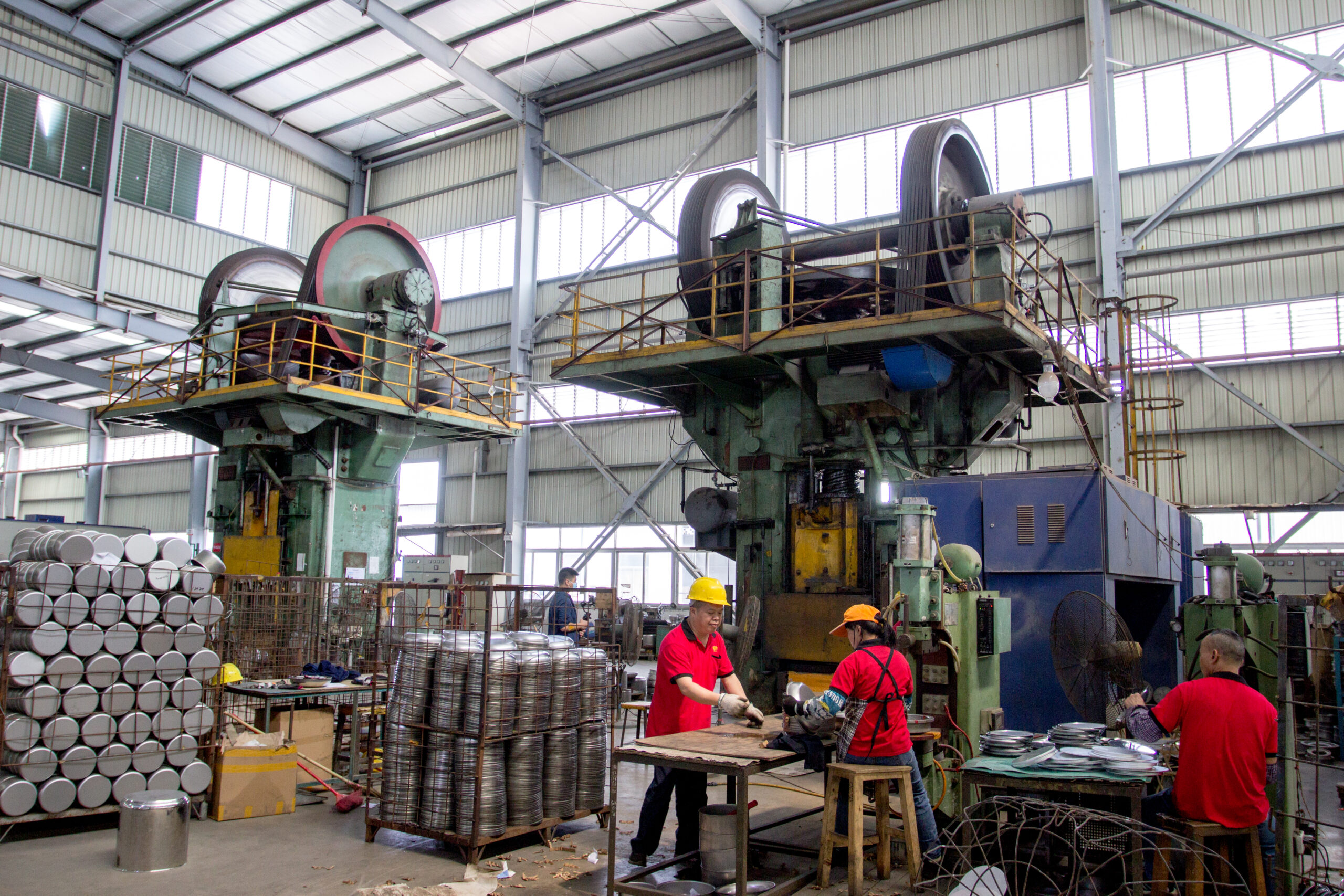
Understanding how impact bonding actually happens on the factory floor explains why high-tonnage solid-state bonding outperforms furnace brazing by a wide margin. Unlike brazing—which relies on melting a separate filler alloy in an oven—impact bonding uses intense kinetic energy and controlled preheating to achieve direct metal-to-metal solid-state interlocking across five precision steps (see the complete coil-to-pot workflow in how stainless steel cookware is made):
- Deep drawing and bottom degreasing: Flat 304 stainless steel blanks are deep-drawn into cylindrical pot bodies, trimmed, and thoroughly degreased. Even microscopic traces of drawing oil or oxide film left on the pot bottom or 430 induction cap will weaken bond strength and cause localized blistering later.
- Micro-texturing and stack assembly: The mating inner surfaces of the 430 cap and pot bottom are prepared (often with fine concentric micro-grooves or shot-blasted texture), and the precision-cut aluminum disc is stacked accurately between them.
- Controlled induction preheating (420 to 480 degrees Celsius): The assembled base components pass through high-frequency induction heating coils until the aluminum core reaches its optimal hot-forging plasticity window—soft enough to flow under pressure, yet well below aluminum’s 660 degrees Celsius melting point so no liquid solder or slag forms.
- High-energy impact strike (1,000 to 2,500 metric tons): A heavy mechanical friction screw press or high-speed hydraulic impact press strikes the preheated stack in a single calibrated blow. Under extreme pressure, the plastic aluminum extrudes microscopically into the surface topography of both the 304 pot base and the 430 induction cap, locking all three layers together permanently with zero air gaps.
- Edge encapsulation, lathe turning, and flatness calibration: The bonded base perimeter is precision-turned on a CNC lathe so the stainless steel cap fully wraps and seals the aluminum core—or finished cleanly flush—before mirror/satin polishing and ultrasonic bond inspection.
Why do impact bonded bases warp, buzz, or delaminate—and how does good engineering prevent it?
Even though impact bonding is far more durable than budget brazing, poorly engineered or under-pressed impact bonded cookware can still suffer three field failures: base warping (spinner pans on glass cooktops), thermal-shock delamination, and dishwasher edge corrosion. Every one of these failures traces back to predictable metallurgical causes that quality factories eliminate during tooling design and QC.
1. Cold-concave crown engineering prevents induction warping
Aluminum has a linear thermal expansion coefficient roughly twice that of 430 stainless steel (~23 x 10^-6 /K vs. ~10.5 x 10^-6 /K). When an impact bonded pan heats up on a 200 to 250 degrees Celsius induction hob, the aluminum core expands outward faster than the surrounding steel. If the pan bottom is machined dead-flat at room temperature, it bows outward (convex) when hot and spins uncontrollably on flat glass cooktops. Precision manufacturers engineer a controlled 0.1 to 0.3 mm inward concave crown when cold; as the pan heats to cooking temperature, differential expansion pulls the base completely flat for 100% cooktop contact.
2. Full stainless-steel edge encapsulation stops dishwasher corrosion
In low-cost impact bonded pots where a thin ring of raw aluminum remains exposed along the outer seam of the bottom disc, highly alkaline automatic dishwasher detergents chemically attack the aluminum layer over 12 to 24 months—etching a recessed trench around the base that traps dirty water and eventually compromises the bond. Specifying a fully encapsulated 430 steel wrap-around edge (also called an enclosed impact-bonded base) seals the aluminum completely away from water and detergents so the cookware remains genuinely dishwasher-safe.
3. Sufficient press tonnage and thermal-shock qualification prevent delamination
Delamination happens when insufficient press tonnage, uneven die parallelism, or contaminated pre-bond surfaces leave weak zones that split apart under repeated heating and cooling cycles. Qualified cookware factories validate every new diameter die using destructive cross-section peel tests, hot-spot infrared thermal mapping (detailed in our cookware hot-spot mapping guide), and multi-cycle thermal-shock tests (heating dry to 250 degrees Celsius and quenching in cold water without blistering or separation).
Which cookware pieces perform best with an impact bonded bottom vs. full tri-ply clad?
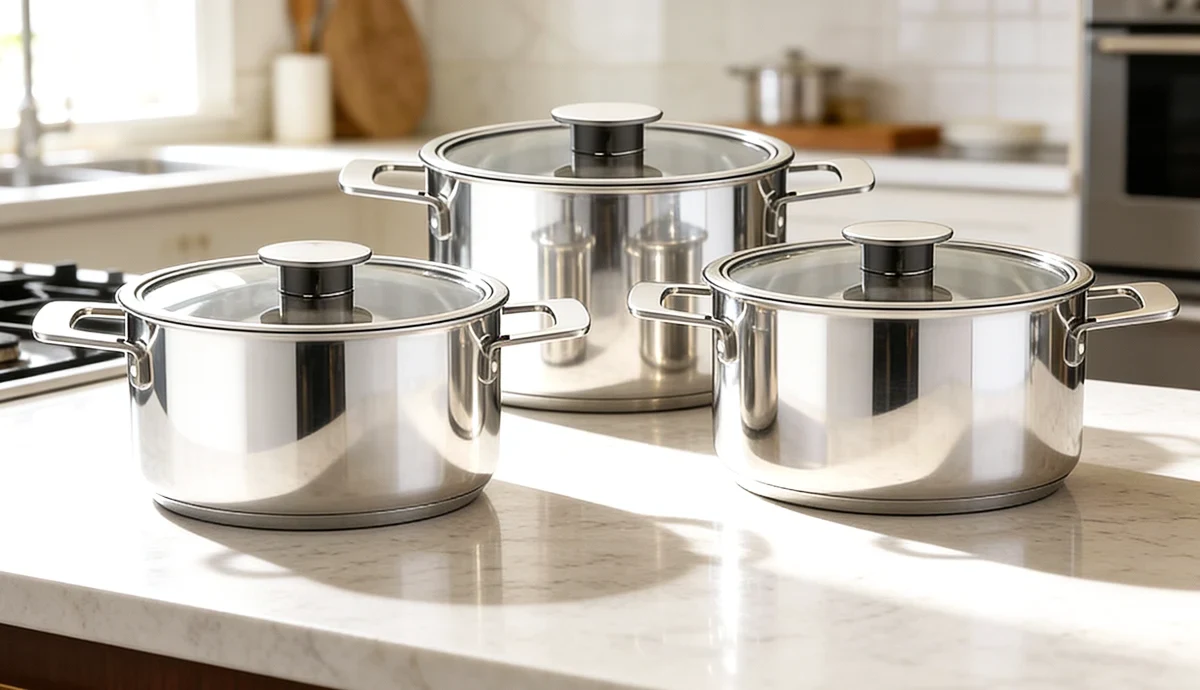
Experienced chefs and B2B product managers rarely choose one construction blindly for every shape in a 10-piece cookware set. Because impact bonded bases excel at vertical bottom-up heat transfer while keeping tall walls lightweight, they are often the superior engineering choice for liquid-heavy vessels, whereas full tri-ply shines in wide reduction pans:
- Stockpots, pasta pots, soup pots, and steamers (Impact Bonded Wins): When boiling 6 to 12 liters of water, broth, or soup, convective liquid circulation distributes heat up the pot naturally. A thick 4.0 to 5.0 mm impact bonded base boils water faster on induction than thin 2.5 mm tri-ply while keeping a full 8-quart stockpot noticeably lighter and more affordable.
- Everyday saucepans and Dutch ovens (Impact Bonded Value Leader): For boiling grains, blanching vegetables, and reheating soups, a 3.5 mm edge-to-edge impact bonded base delivers fast, responsive heat without the premium price tag of 5-ply clad steel.
- Commercial HoReCa braisers and large catering kettles (Heavy-Gauge Impact Bonded): Restaurant kitchens favor 4.5 to 5.5 mm impact bonded bases on 28 cm to 40 cm heavy pots because the massive aluminum disc resists warping on 3.5 kW to 5 kW commercial induction ranges.
- Wide skillets, sauciers, and saute pans (Consider Tri-Ply for Flagship Tiers): For delicate wine reductions, caramel, or high-heat steak searing where food climbs the curved walls, fully clad tri-ply eliminates the “heat step” at the base-to-wall transition—though a well-engineered edge-to-edge impact bonded skillet remains a strong mid-tier seller.
How should consumers care for impact bonded bottom cookware to maximize lifespan?
With proper heat management, a well-made impact bonded stainless steel pot easily lasts 15 to 25+ years in a residential kitchen. Following four simple care rules eliminates the two main causes of premature base fatigue—thermal shock and harsh chemical pitting:
- Avoid extreme thermal shock: Never plunge a searing-hot empty pan directly under cold tap water. Allow the bonded base to cool for 3 to 5 minutes before washing so the aluminum core and 430 steel cap contract smoothly together.
- Match burner size to the bonded disc diameter: On gas stoves, keep flames underneath the bonded base rather than licking up the single-ply stainless sidewalls, which causes rainbow heat tinting and scorched residue near the upper rim.
- Preheat gradually on induction cooktops: Modern induction boost modes can drive a 430 steel base above 260 degrees Celsius in under 45 seconds when dry. Start on medium power (level 5 to 6 of 10) for 60 to 90 seconds before adding oil or raising heat.
- Inspect the base edge before dishwashing: Fully enclosed impact bonded bases handle automatic dishwashers safely, while exposed-edge aluminum bases should always be hand-washed with mild neutral detergent to prevent alkaline aluminum corrosion.
What specifications and QC tests should B2B importers include in an OEM cookware RFQ?
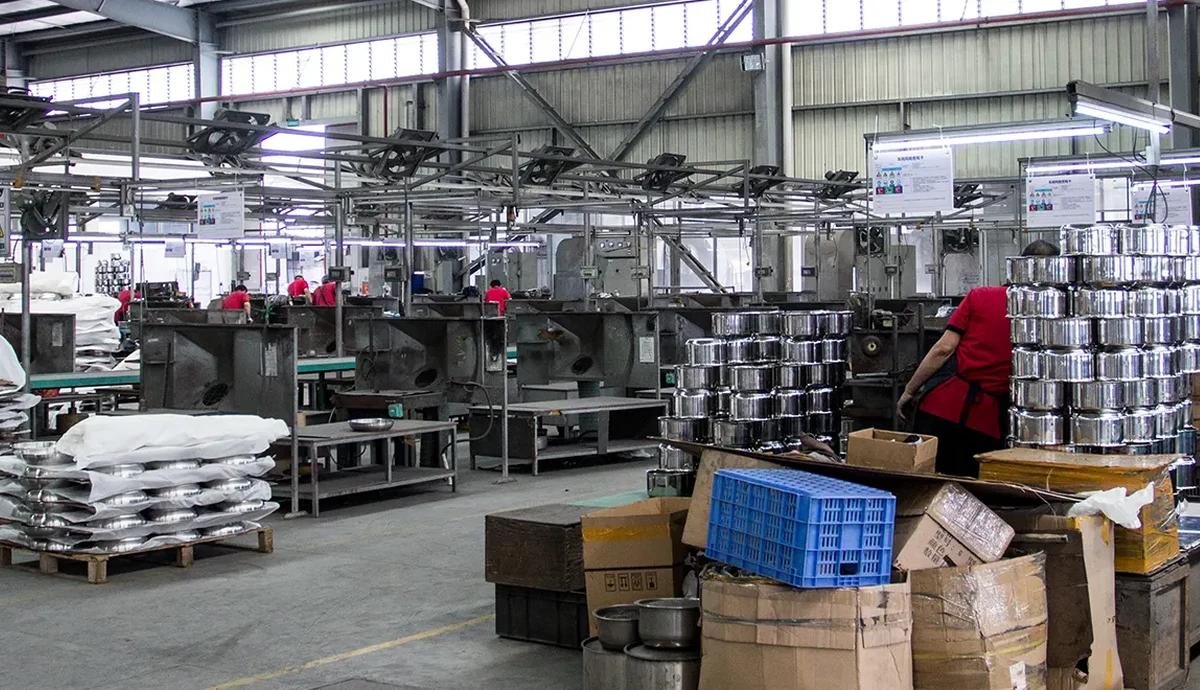
When sourcing impact bonded stainless steel cookware for private-label retail, department stores, or hospitality distribution, vague requests like “tri-ply bottom stainless steel pot” invite hidden downgrades in aluminum thickness and bonding method. Include these seven concrete specifications in your RFQ and sample-validation protocol:
| Specification Item | Promotional / Entry Retail | Mainstream / Branded Retail | Commercial / HoReCa Grade |
|---|---|---|---|
| Body Steel Grade & Wall Thickness | 304 SS (0.5 mm) | 304 SS (0.6 – 0.7 mm) | 304 or 316L SS (0.8 – 1.0 mm) |
| Aluminum Core Disc Thickness | 2.0 – 2.5 mm (1050/3003 Al) | 3.0 – 4.0 mm (1050 pure Al) | 4.5 – 5.5 mm (1050 pure Al) |
| Outer Induction Cap | 430 SS (0.4 mm) | 430 SS (0.5 mm, enclosed edge) | 430 SS (0.5 – 0.6 mm, fully sealed) |
| Bonding Method Requirement | Impact bonded (verify vs. brazed) | 1,600+ ton impact bonded | 2,000+ ton impact bonded |
| Cold Flatness Tolerance | 0.0 to 0.4 mm concave | 0.1 to 0.3 mm concave | 0.1 to 0.25 mm concave (zero convex) |
| Thermal-Shock QC Standard | 5 cycles (220 C -> water) | 10-15 cycles (250 C -> water) | 20+ cycles (260 C -> cold water) |
| Food-Contact & Safety Docs | FDA / LFGB 304 steel cert | FDA, LFGB, EN 12983-1 report | NSF, LFGB, FDA, heavy-duty handle load test |
Before placing a bulk container order, request one sacrificial cut-open cross-section sample from the factory to verify actual aluminum core thickness with digital calipers, check that zero air gaps exist along the 304-to-Al and Al-to-430 bond lines, and confirm handle temperature stability and mirror-polish consistency. Learn how to structure your factory evaluation in our stainless steel cookware buying guide for importers and private-label brands and our cookware set configuration guide.
Frequently asked questions about impact bonded bottom cookware
Is impact bonded bottom cookware induction compatible?
Yes, almost all modern impact bonded stainless steel cookware is fully induction compatible because the outermost bottom cap is formed from ferromagnetic 430 stainless steel. Verify with a fridge magnet on the underside of the base and confirm a slight cold-concave flatness profile so the pan sits silently and evenly on glass induction cooktops.
What is the difference between impact bonded and encapsulated (brazed) bottom cookware?
Both constructions attach an aluminum-core disc to the bottom of a stainless steel pot, but impact bonding fuses the metals permanently under 1,000 to 2,500 tons of mechanical impact pressure with zero filler metal, whereas brazed encapsulation solders the disc on in a furnace using a melting filler alloy. Impact bonding eliminates solder micro-voids, delivers quieter induction heating, and resists delamination far longer.
Is impact bonded cookware oven-safe and dishwasher-safe?
An impact bonded base itself is typically oven-safe up to 260 degrees Celsius (500 degrees Fahrenheit), though actual oven limits depend on whether the pot uses stainless steel handles, phenolic/silicone grips, or tempered glass lids (usually 180 to 220 degrees Celsius). For dishwashers, choose fully enclosed stainless-wrapped impact bonded bases so alkaline detergents cannot corrode an exposed aluminum rim.
How thick should the aluminum disc be in a good impact bonded pot?
For reliable everyday home cooking without hot spots or warping, look for a minimum 3.0 to 4.0 mm pure aluminum core disc inside an impact bonded base. Heavy commercial restaurant stockpots and induction catering pans benefit from 4.5 to 5.5 mm aluminum discs to absorb high-wattage induction bursts smoothly.
Can an impact bonded bottom separate or fall off over time?
High-tonnage impact bonded bases from qualified factories rarely separate under normal cooking, as the solid-state aluminum-to-steel interlock withstands thousands of thermal cycles. Separation almost always stems from poor low-tonnage manufacturing, brazed substitutes, or repeated extreme thermal shock such as running cold water into a dry, overheating pan.
Source custom impact bonded stainless steel cookware from Changwen Cookware
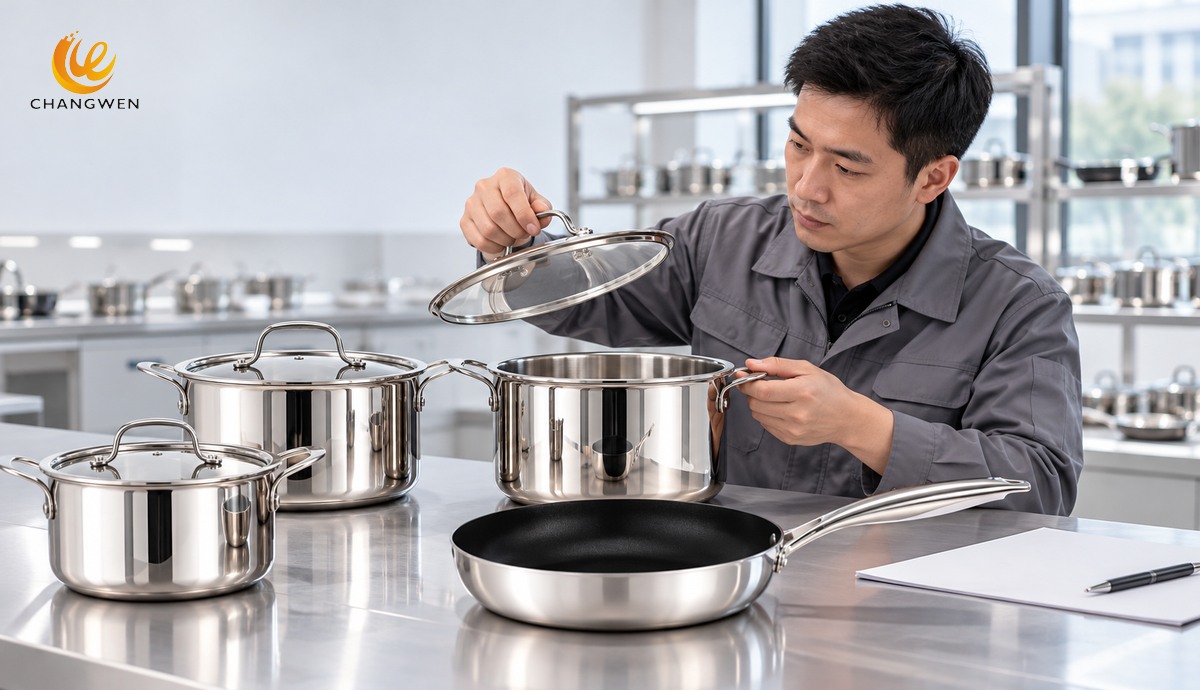
Whether you are a cookware brand launching a high-value induction set, an international importer configuring 5- to 12-piece stainless steel collections, or a commercial hospitality distributor specifying heavy-gauge HoReCa stockpots, partnering directly with an experienced impact-bonding manufacturer guarantees consistent base thickness, flat induction performance, and verified thermal-shock durability.
Explore our full range of stainless steel pots, pans, and multi-piece sets on our product catalog, review our OEM/ODM capabilities on our custom kitchenware page, and inspect our factory testing protocols on our quality control page. Ready to compare impact bonded aluminum core thicknesses, request a cut-section quality sample, or receive a B2B wholesale quotation? Contact our team today for specifications, samples, and factory-direct pricing.
-
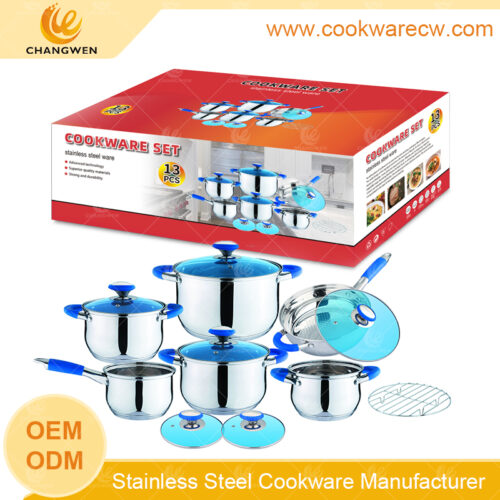
Wholesale price stainless steel pots and pans mirror polished cookware set saucepan milkpot casseroles with blue silicone and blue glass lids steamer wire rack CW-M1307G-01
-
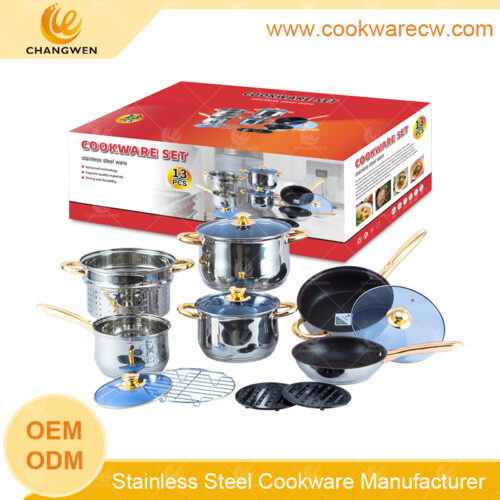
Factory Wholesaler 13 pcs nonstick stainless steel cookware set fry pan saucepan casserole steamer rack black mats CW-M1301
-
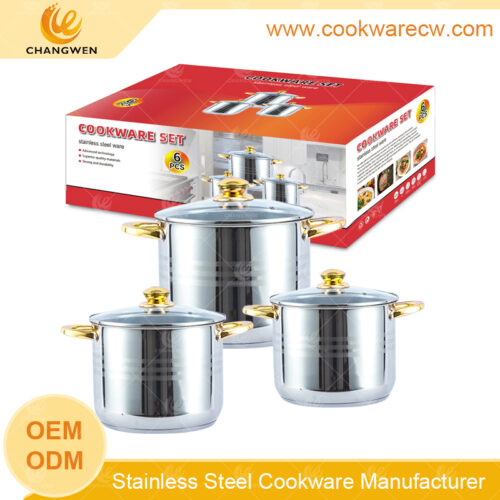
Heavy Duty Stock Pots Stainless Steel CW-M0607
-
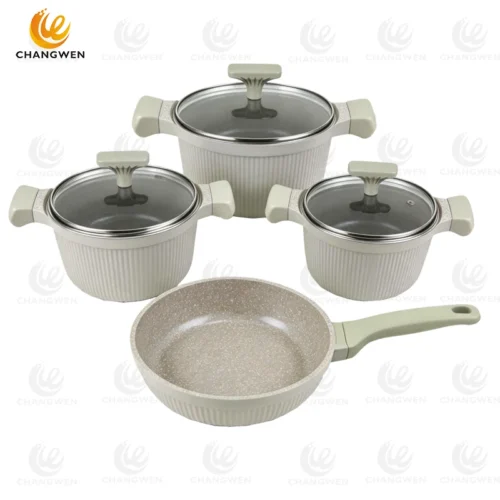
7pcs Vertical Stripe Nonstick Aluminum Cookware Set with Silicone Lid | Changwen Aluminum Cookware Factory China
-
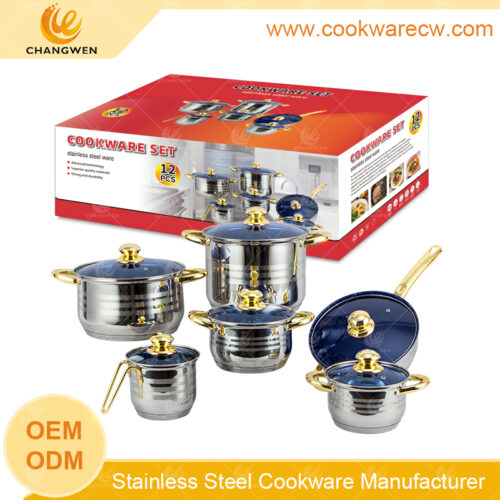
heavy S/S 12pcs cookware set pots wholesale nonstick fry pan blue glass lid golden handle cooking pan milk pot CW-M1222
-
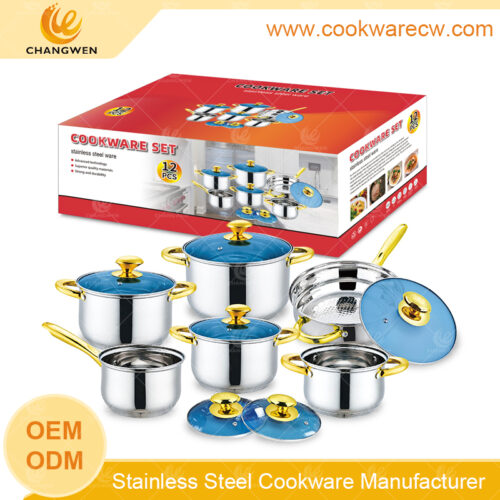
Mexican hottest stainless steel 12pcs cook pot frying pan with blue glass lid golden handle & knobs and 7 steps capsuled bottom CW-M1209
-
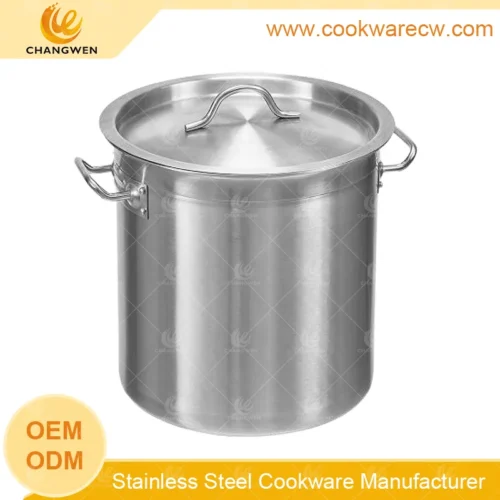
Heavy Duty Stainless Steel Cooking Utensils
-
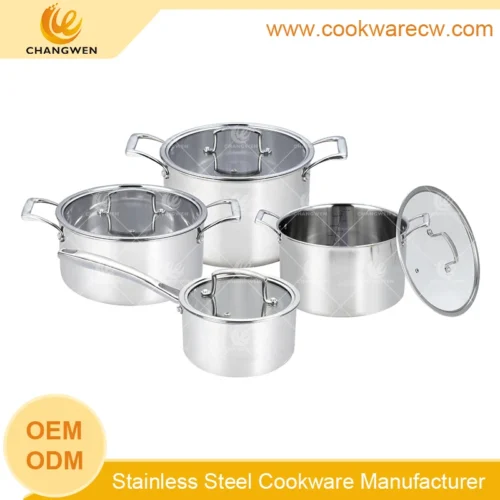
Premium Stainless Steel Cookware Set for Modern Kitchens CW-ETP0801